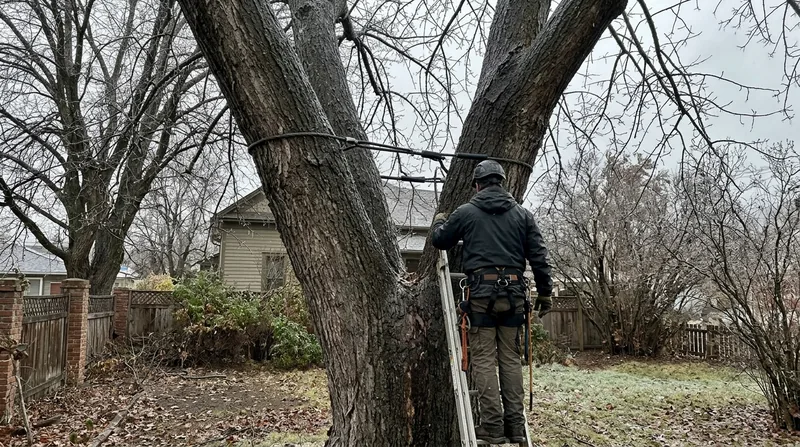




Tree cabling and bracing in Kamloops addresses a specific problem: a mature silver maple with a weak fork, a black locust split by an ice storm, or an oak leaning over a driveway after a windstorm. Our ISA Certified Arborists inspect the tree first, because a cable only helps if the wood is sound enough to keep. We install flexible cables and steel rods to reduce the risk of failure under snow and wind, and we document every installation so you have a clear record of the work. If you are comparing companies, ask for the inspection report before anyone quotes hardware. You can review our tree pruning service for the structural work that often accompanies a cabling job.
Why cabling and bracing matters for mature trees in Kamloops
Many Kamloops neighbourhoods have post-war subdivisions with mature street trees that were planted close to houses and driveways. Silver and sugar maples, red and white oaks, and ash weakened by the emerald ash borer all develop included bark, narrow forks, and long limbs that catch snow and wind. A flexible cable shares the load between two stems; a steel rod through a split crotch holds the wood together. Neither replaces pruning, but both buy time for a tree you want to keep.
- We inspect the fork, the root flare, and the canopy before recommending any hardware.
- We install flexible cables in weak unions to limit movement without rigidizing the tree.
- We use steel rods through split limbs or cavities where a cable alone would not hold.
- We record the hardware type, height, and date so future inspections have a baseline.
Homeowners in Sahali and South Kamloops often call after a windstorm because a limb has moved more than usual; an inspection tells you whether cabling is appropriate or whether removal is the safer choice.
Key fact: A typical residential cabling job in Kamloops with two cables and an inspection starts around $450 to $900, depending on tree height and access. A large silver maple in a tight backyard off a ravine lot can reach $1,200 or more because the crew needs rigging and a longer setup.
For the official context on tree protection and permits, see the City of Kamloops website before you schedule any structural work.
How we install cables and braces, step by step
Every installation follows the same sequence, whether the tree is a Norway spruce in Logan Lake or a black locust in a Downtown backyard. The goal is to reduce risk without creating a rigid structure that transfers stress to another part of the tree. We work with the canopy you have, not against it.
- We start with a visual inspection of the crown, trunk, and root zone, and we note any decay, cracks, or previous hardware.
- We measure the span between the two attachment points and select cable or rod hardware rated for the load.
- We climb or use a lift to install the hardware at the correct height, usually two-thirds of the way up the affected stems.
- We tension the cable so it shares load without pulling the stems together, and we check the installation from the ground.
- We clean up all debris and leave you a written record of the hardware and the date.
If the inspection shows the tree is not sound enough to cable, we tell you clearly and discuss removal options rather than installing hardware that will not hold.
Key fact: On a recent job in a Kamloops neighbourhood, a red oak with a narrow fork over a driveway needed two flexible cables at 9 metres. The installation took half a day, and the homeowner received a photo record for their files. The alternative, removing the oak, would have cost several times more and changed the shade profile of the front yard.
If your tree also needs structural pruning before cabling, our tree trimming page explains how we reduce end weight on long limbs.
Cabling methods and when we use them
The method depends on the defect, the species, and the access. A flexible cable suits a weak fork that still has sound wood; a steel rod suits a split or cavity that needs direct support. We choose based on the inspection, not on a catalogue. The table below summarizes the common options we install in the Kamloops area.
| Method | Description | Context |
|---|---|---|
| Flexible steel cable | A multi-strand cable anchored in both stems, tensioned to share load without rigidizing the tree. | Weak forks in maple, oak, and ash where the wood is still sound. |
| Steel rod through a crotch | A threaded rod drilled through a split or narrow union, with washers and nuts to hold the wood together. | Split limbs after an ice storm or a cavity that a cable cannot support. |
| Combination cable and rod | A rod through the union plus a cable higher in the crown to limit movement. | Large mature trees with both a split and long, heavy limbs. |
| Dynamic support (no hardware) | Pruning and reduction cuts to lower end weight instead of installing hardware. | Younger trees or unions that respond well to structural pruning. |
We recommend the least invasive option that addresses the defect, and we explain why the other methods are not needed.
Permits, clearances, and debris: what applies in Kamloops
Before any hardware goes in, we confirm whether the work touches a regulated tree or a protected area. The City of Kamloops may require a permit for a private tree removal, and the application is normally supported by an arborist report; rules and thresholds differ from one municipality to the next across the Kamloops area. We also respect approach distances near your private electrical service entrance. The public distribution network of BC Hydro is never touched: if a limb is contacting the public lines, we refer the matter to BC Hydro and keep our crew clear. Debris from cabling and pruning is chipped and removed the same day, and we leave the work area clean.
If you need documentation for a permit application or for your own records, our arborist report service provides the written assessment that supports the file.
When to schedule cabling and bracing
The best window for structural work is dormancy, from late fall to late winter, when the canopy is bare and the wood is visible. Cabling can be installed outside that window if a storm has opened a split, but the inspection is easier when leaves are down. Ice storms and summer windstorms drive most emergency calls, and we respond year-round for those. If you are planning ahead, book the inspection in late fall so the hardware can go in before the snow load arrives.
For a free estimate, call (778) 652-1933 or visit our contact page. We serve Kamloops and Logan Lake, and we will tell you honestly if cabling is the right choice for your tree.
Prices Tree Cabling & Bracing in Kamloops — Indicative pricing
| Service | Price | Details |
|---|---|---|
| Inspection and written recommendation | From $150 | Visual assessment of the fork, trunk, and root zone, with a written recommendation. |
| Single flexible cable installation | From $450 | One cable installed in a weak fork, including hardware and clean-up. |
| Two-cable installation | From $750 | Two cables in the same tree, typical for a large maple or oak. |
| Steel rod through a split crotch | From $600 | Rod, washers, and nuts installed through a split or cavity. |
| Large or difficult access | On estimate | Ravine lots, tight backyards, or trees over 15 metres. |
| Travel | Included | In Kamloops and the surrounding area. |
| Estimate | Free | Response within 24 hours at (778) 652-1933. |
Indicative prices; free, personalized estimate within 24h at (778) 767-0989.